When our customer buy a refrigeration unit for their walk-in cooler, it is very important to know walk in cooler refrigeration unit sizing.
Walk-in coolers are the one of the main commercial food storage, like restaurant walk in cooler, supermarket walk in cooler, hotel walk in cooler, food processing walk in cooler, beverage storage walk in cooler, agricultural Walk In Cooler, pharmaceutical walk In cooler, flower walk in cooler and so on. The proper walk in cooler refrigeration unit sizing is the key to keep the temperature reliably, runs efficiently, and keeps food safe.
If the walk-in cooler refrigeration unit is undersized, means that the cooling capacity of the refrigeration unit is lower than the actual walk in cooler btu sizing, it can’t reach the target temperature or it can’t maintain the target temperature after a large amount of food entering into the walk-in cooler, resulting in walk-in cooler temperature fluctuation. If the walk-in cooler refrigeration unit is oversized, means the cooling capacity of the refrigeration unit is larger than the actual walk in cooler btu required. The oversized walk-in cooler refrigeration unit is not only wasting energy, but also causing compressor ON and OFF frequently.
So Glen Refrigeration helps our users to know more about Walk-In Cooler Refrigeration Sizing.
How To Size A Walk In Cooler Refrigeration Unit?
Undersized and oversized refrigeration unit are both not good for the walk-in cooler. So it is very important for our customer to know how to size a refrigeration unit for a walk-in cooler.
The walk in cooler refrigeration unit sizing is not only be determined by the walk-in cooler dimension, but also depends on target temperature, ambient temperature, walk-in cooler panel thickness and insulation, product load, door openings, and required pull-down time and other heat loads such as lights, fan, machinery, personal, defrost loads etc.
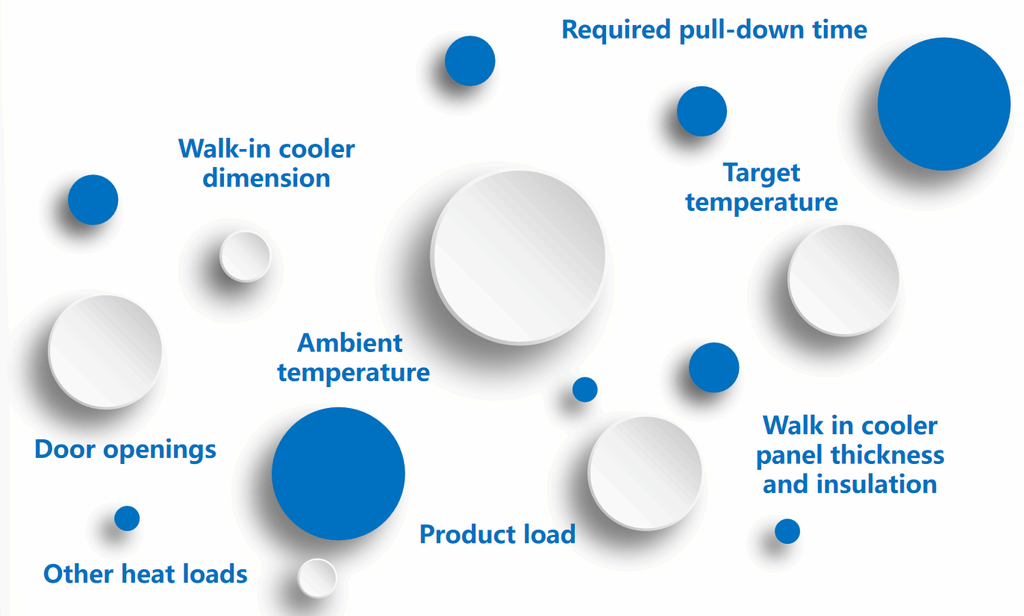
So we need to calculate the total refrigeration load. Here is the total refrigeration load calculation formula.
Total refrigeration load=(Transmission load+Product load+Internal load+Infiltration load)* safety factor.
(The total refrigeration load is the sum of all heat entering into the walk in cooler.)
- Transmission Load: The heat transfer through walk-in cooler wall panels, roof panels and floor panels. The insulation performance of the walk in cooler panels affects the heat load directly. The better the walk in cooler insulation, the lower heat load. Generally, the lower the walk in cooler temperature, the thicker the cold room panels required.
| Cold storage room temperature | Polyurethane sandwich panel thickness |
| 2~8℃ | 100mm polyurethane sandwich panel |
| -18℃ | 100mm or 120mm polyurethane sandwich panel |
| -25℃ | 150mm polyurethane sandwich panel |
- Product Load: The walk-in cooler refrigeration unit need to remove the heat generated by the goods. The quantity and the temperature of goods entering the walk in cooler decide the product heat load that need to be removed.
- Internal Load: Heat from lighting or evaporator fan motors
- Infiltration Load: The heat from outside hot air entering when opening the walk in cooler doors. The door opening frequency and duration of each opening are two main factors. If doors opened and closed frequently, the compressor will work at a overload condition in a long time, leading to increased energy consumption and frequent temperature fluctuations in the cold storage.
Combing the refrigeration heat load calculation and actual design condition, then we can select a suitable walk-in cooler refrigeration unit.
The refrigeration load calculation software is very important, if we have not refrigeration load calculator free download, we also can calculate the total refrigeration load according to:
- Walk-in cooler specifications
- Walk-in cooler target temperature
- Walk-in cooler ambient temperature
- Walk-in cooler insulation material, like walk in cooler floor insulation and walk in cooler wall panels
- Product quantity and temperature entering the walk-in cooler
- Walk in cooler door opening frequency
- Walk-in cooler internal heat load
What is The Walk-in Cooler Specifications?
The walk-in cooler specification is one of the factors determined the walk in cooler refrigeration unit sizing. Generally speaking, the larger the size of the walk-in cooler, the larger the refrigeration load, and the larger the walk in cooler condensing unit capacity required.
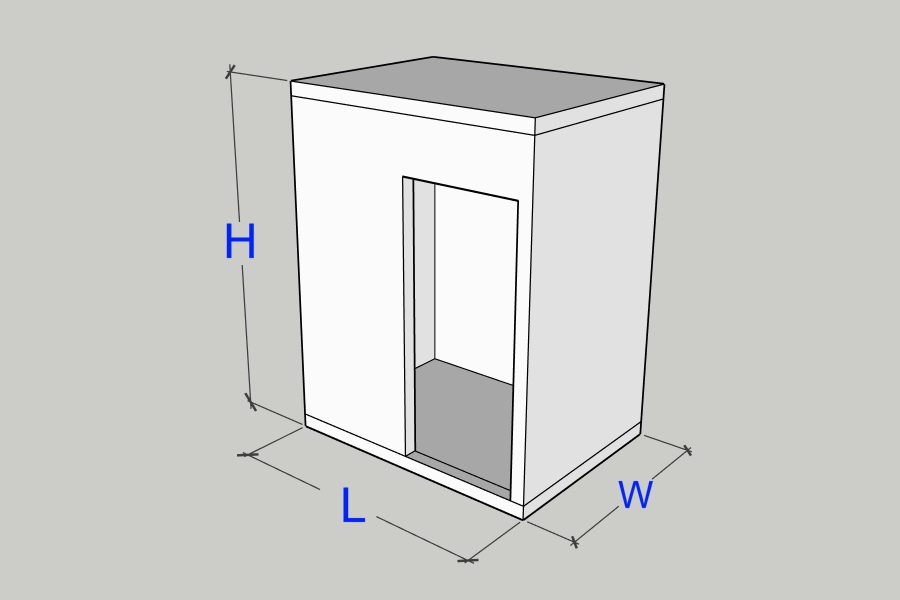
It is easy to calculate the walk-in cooler dimensions. Firstly we need to measure the external length, width and height of the walk-in cooler. Then use walk in cooler size calculator. Please see below:
How to calculate measure in feet?
Multiply length × width × height. Example: A walk in cooler 6 feet long, 6 feet wide, and 8 feet high is 288 ft³ (6 × 6 × 8).
Generally, please see the standard walk in cooler dimensions below:
| Dimensions (L×W×H) | Volume |
| 6′ × 6′ × 8′ | 288 cu.ft |
| 6′ × 8′ × 8′ | 384 cu.ft |
| 6′ × 10′ × 8′ | 480 cu.ft |
| 8′ × 8′ × 8′ | 512 cu.ft |
| 8′ × 10′ × 8′ | 640 cu.ft |
| 10′ × 10′ × 8′ | 800 cu.ft |
| 10′ × 12′ × 8′ | 960 cu.ft |
| 12′ × 12′ × 8′ | 1152 cu.ft |
Except these standard walk-in coolers, there is also many custom walk in coolers. Whether standard walk in cooler dimensions or customized dimensions, the walk-in cooler size calculator is same.
What is The Walk-in Cooler Target Temperature?
The walk-in cooler target temperature is also the walk in cooler operating temperature or refrigeration temperature.
Firstly, we need to distinguish walk in cooler and walk in freezer. Because walk-in cooler and a walk-in freezer refrigeration load calculation is different.
Generally walk in cooler operates around around 35°F to 38°F; while the walk in freezer around -0.4°F or lower. For same sizing of walk in cooler and walk in freezer, walk in freezer refrigeration unit requires more refrigeration capacity btu, please see below:
- The walk in freezer refrigeration unit requires more refrigeration cooling capacity to maintain a much larger temperature difference between the inside of the walk in freezer and the surrounding ambient temperature.
- During the freezing process, the freezing of moisture inside of the goods will release a large amount of heat.
- Under low temperature refrigeration, the actual cooling capacity of the compressor will decrease. That means same compressor, the cooling capacity at evaporating temperature 23°F will be lower than -13°F
If you are storing frozen food, ice cream, meat, seafood, or other frozen products, please see Walk-In Freezer Refrigeration Sizing Guide: What Size Refrigeration Unit Do I Need?
Secondly, for walk in cooler application, different food, the walk in cooler refrigeration temperature will also have slight difference.
| Item | Storage temperature |
| Fresh Meat and Seafood | 28°F to 32°F (-2°C to 0°C) |
| Dairy Products | 34°F to 38°F (1°C to 3°C) |
| Produce (Fruits and Vegetables) | 32°F to 50°F (0°C to 10°C) |
| Beer and Beverages | 35°F to 38°F (2°C to 3°C) |
| Cut Flowers | 33°F to 35°F (0.5°C to 2°C) |
What is Walk In Cooler Ambient Temperature?
The ambient temperature is the temperature around the walk in cooler and the walk in cooler refrigeration unit. If the ambient temperature is high, the walk in cooler refrigeration unit works harder. So walk in cooler ambient temperature should also be consider during cold storage design calculation.
The ambient temperature determines heat load directly.
The higher the ambient temperature, the greater the temperature difference between the inside and outside of the walk in cooler, and the more heat is transferred through the walk in cooler panels. The walk in cooler located in high ambient temperature or tropical climate will significantly increase cooling load.
High ambient temperatures can also lead to decreased condenser heat dissipation efficiency (especially in air-cooled units), further weakening the cooling capacity. Same compressor or same condensing unit, under 40°C ambient temperature and 50°C ambient temperature, the cooling capacity will have 10% to 20% difference.
It is also the reason that we need to enlarge the condenser coil of the condensing unit used in high ambient temperature or tropical climate. The bigger condenser coil enlarge the heat exchange area, reducing the condensing temperature, ensuring the walk in cooler refrigeration unit operating efficiently.
If the condensing unit is installed inside a room without good heat dispassion, it not only increase the compressor load, but also cause high pressure protection.
What is Walk-in Cooler Insulation Material?
The most recommended walk in cooler insulation material is polyurethane (PU) sandwich panels, which consist of high-density polyurethane foam sandwiched between metal panels (color steel plates, stainless steel, or aluminum plates).
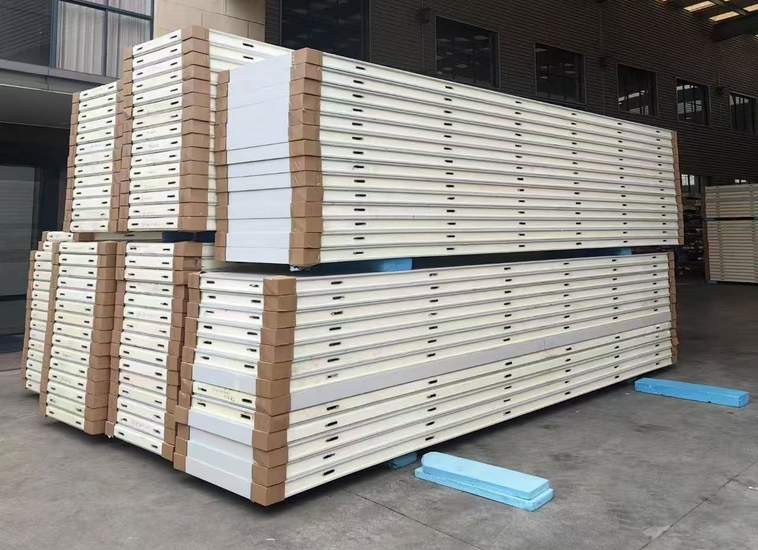
The high-density polyurethane (PU) sandwich panels have superior insulation performance, high structural strength and easy installation. Please visit: Looking for high-quality walk in cooler panels?
Polyurethane (PU) sandwich panels thickness: 75mm, 100mm, 120mm, 150mm, 200mm. Different usage walk in cooler require different insulation thickness:
- 100mm polyurethane sandwich panels: Suitable for walk in cooler refrigeration (above 0℃) and also for walk in freezer (-18℃), such as restaurant walk in cooler, supermarket walk in cooler, hotel walk in cooler, food processing walk in cooler, beverage storage walk in cooler, agricultural Walk In Cooler, pharmaceutical walk In cooler, flower walk in cooler and so on.
- 120mm polyurethane sandwich panels: Suitable for walk in freezer (-18℃).
- 150mm and above polyurethane sandwich panels: Used for quick-freezing and blast freezer room below -25℃, such as storing seafood and ice cream.
What is Product Quantity and Temperature Entering the Walk-in Cooler?
The refrigeration unit for walk in cooler also need to consider the product load, including the product quantity and product temperature.
If the products have already been chilled before entering the walk-in cooler, the refrigeration unit for walk in cooler can be selected according to the walk in cooler dimension. It is easy to select with the walk in cooler btu calculator.
But if you load warm products into the walk-in cooler, it needs to calculate the incoming product load according to the quantity and incoming temperature. Because the refrigeration system must remove heat from that product until it reaches the holding temperature.
The walk in cooler product load calculation can be according to:
- How many pounds of product enter the walk-in cooler?
- What’s the temperature of the product when it enters into the walk-in cooler?
- What’s the target holding temperature?
- How quickly the product needs to pull down?
- What type of product being stored?
- What is Walk In Cooler Door Opening Frequency?
The walk in cooler door opening frequency can affect the walk in cooler temperature directly. Because frequently door opening leads to a significant increase and greater fluctuation in cold storage temperature.
Here is the main impacts with walk in cooler door opening frequently:
- Walk in cooler temperature increases instantaneously. When opening the door, the hot air outside of the walk in cooler can enter into the walk in cooler instantaneously and cause the storage temperature to rise by 2–5°C within minutes (depending on the temperature difference, duration of opening, and door sealing).
- Increase the refrigeration load. When the hot air entering into the walk in cooler, the walk in cooler refrigeration unit needs to operate at a high load to recover temperature. If doors opened and closed frequently, the compressor will work at a overload condition in a long time, leading to increased energy consumption and frequent temperature fluctuations in the cold storage.

- It is recommended to install the air cooler evaporator away from the door.
- Reduce the walk in cooler door opening and closing frequency.
What is Walk-in cooler Internal Heat Load?
The walk in cooler internal heat load mainly consists of the following parts:
- Heat dissipation from internal equipment: The heat generated by the operation of fan motors and lighting.
- Defrosting load: The heat generated during defrosting, especially the electric defrosting.
Generally the electric heaters have several kilowatts power, and the electric defrosting period is 25~30 minutes. The heat load generated by the electric defrosting causes the cold room temperature fluctuations, increases energy consumption.
While hot gas defrosting is a energy-efficient refrigeration solution. It replies on the high-temperature refrigerant discharged from the compressor, entering into the evaporator coil to melt frost. Compared with traditional electric defrosting methods, it can reduce defrosting energy consumption by up to 80%, and the defrosting time is only 3 to 5 minutes.
Please visit here: Electric Defrost vs. Hot Gas Defrost in Commercial Refrigeration
How Do I Select Refrigeration Unit For A Walk In Cooler?
According to above, we can use a btu cooling calculator formula to calculate the total refrigeration load.
Total refrigeration load=(Transmission load+Product load+Internal load+Infiltration load)* safety factor.
(The total refrigeration load is the sum of all heat entering into the walk in cooler.)
| Walk-In Dimensions (L×W×H) | Typical Load (BTU/hr) | Heavy Usage Load (BTU/hr) |
| 6′ × 6′ × 8′ | 4,986 | 6,540 |
| 8′ × 8′ × 8′ | 6,258 | 8,340 |
| 10′ × 10′ × 8′ | 9,072 | 10,790 |
Then according to the total refrigeration load to select the refrigeration unit for walk-in cooler. Please see the refrigeration cooling capacity of the wall mount monoblock refrigeration unit.
| Model | Refrigeration Capacity at Different Evaporating Temperature | |||
| -5°C | -10°C | -25°C | -35°C | |
| GL-BYTCN10EL | 4265BTU/h (2250W) | 5322BTU/h (1560W) | 2797 BTU/h (820W) | 2593BTU/h (760W) |
| GL-BYTCN20EL | 14603BTU/h (4280W) | 10407BTU/h (3050W) | 7847BTU/h (2300W) | 5186BTU/h (1520W) |
| GL-BYTCN30EL | 23373BTU/h (6850W) | 14842BTU/h (4350W) | 11021BTU/h (3230W) | 6994BTU/h (92050W) |
| GL-BYTCN40EL | 31050BTU/h (9100W) | 19790BTU/h (5800W) | 13819BTU/h (4050W) | 9690BTU/h (2840W) |
| GL-BYTCN50FL | 36509BTU/h (10700W) | 25932BTU/h (7600W) | 19619BTU/h (5750W) | 12966BTU/h (3800W) |
But the design of a walk in cooler and selection of walk in cooler refrigeration system is a project, the refrigeration btu calculator is just for reference. If you have any questions of walk-in cooler refrigeration sizing, feel free to contact with Glen Refrigeration.
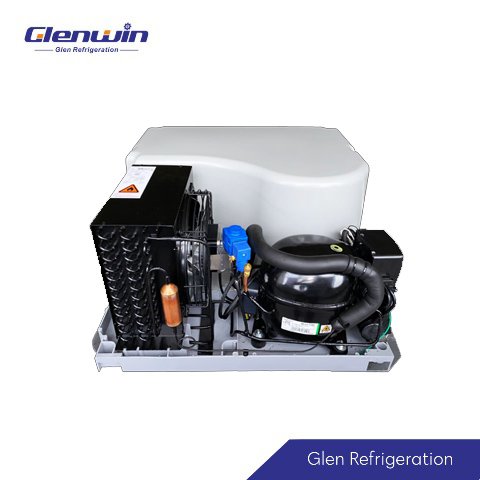
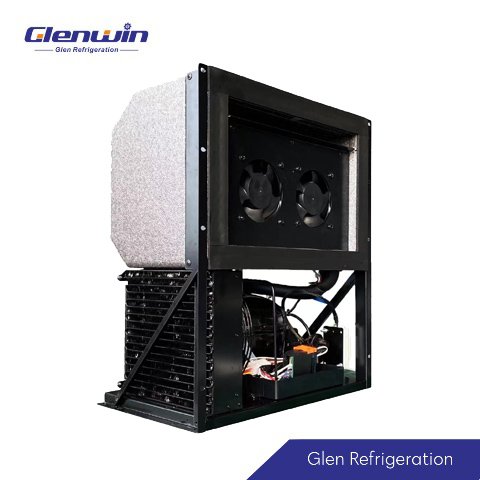
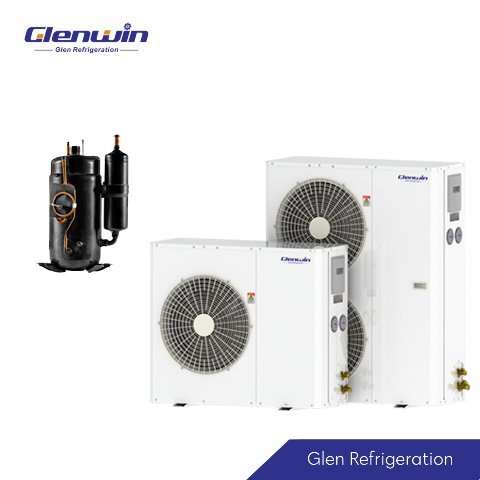
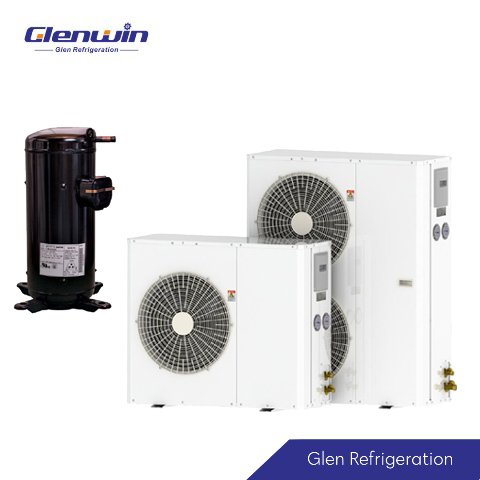
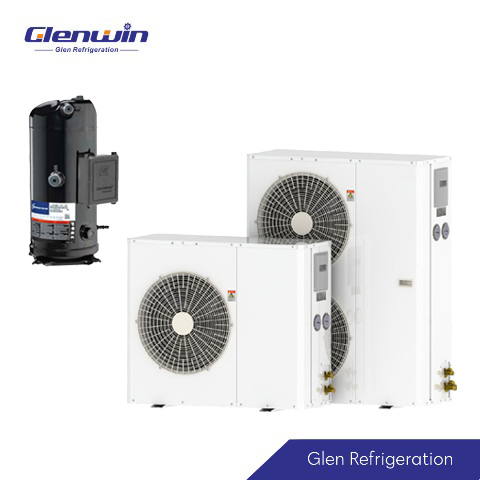
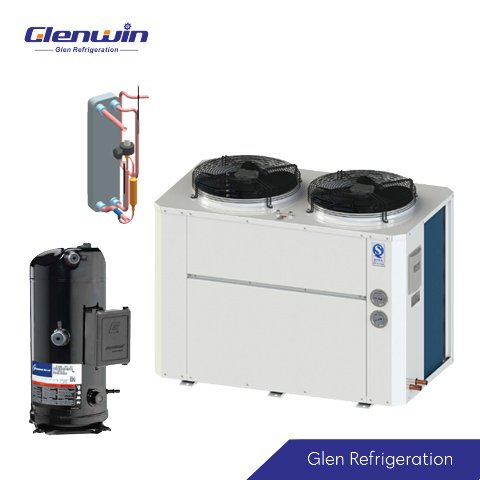
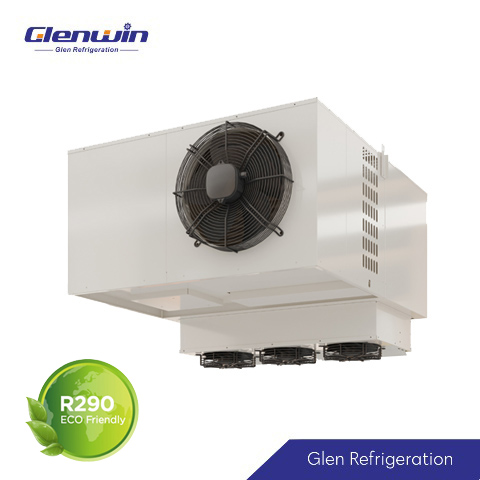
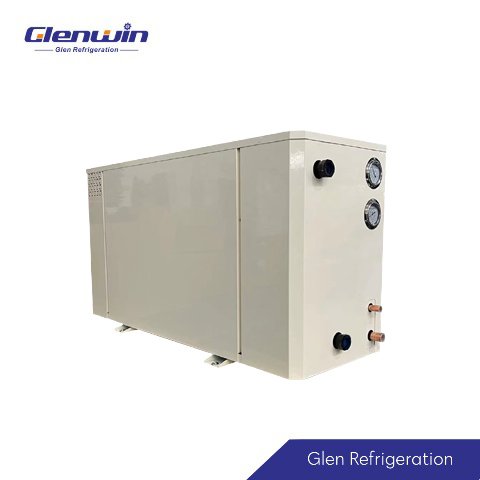
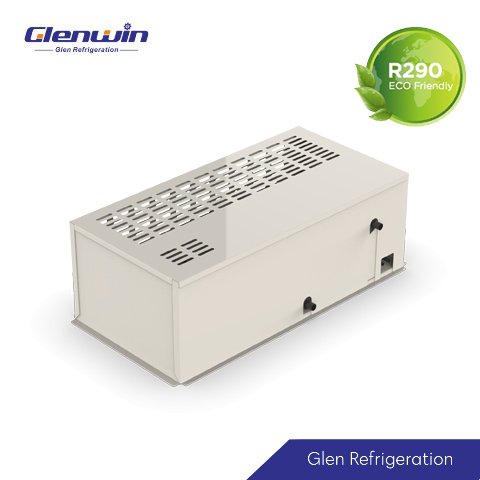
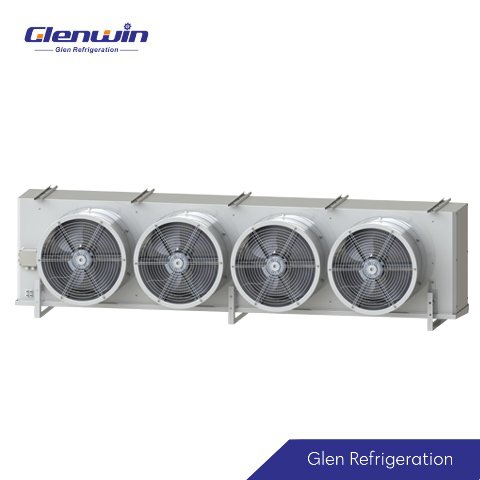
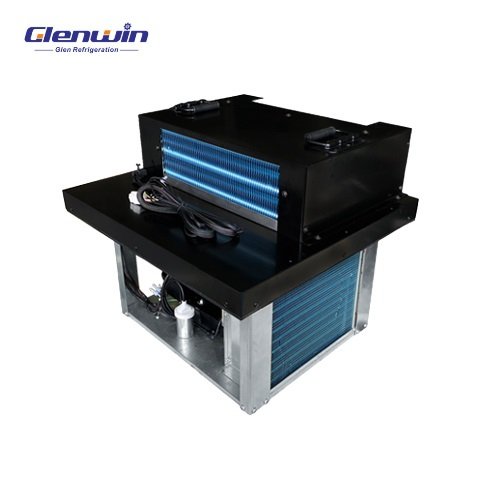
Glen Refrigeration offers Wall Mount Monoblock Refrigeration Unit and Ceiling Mount Monoblock Refrigeration Unit for small and medium size walk-in coolers.
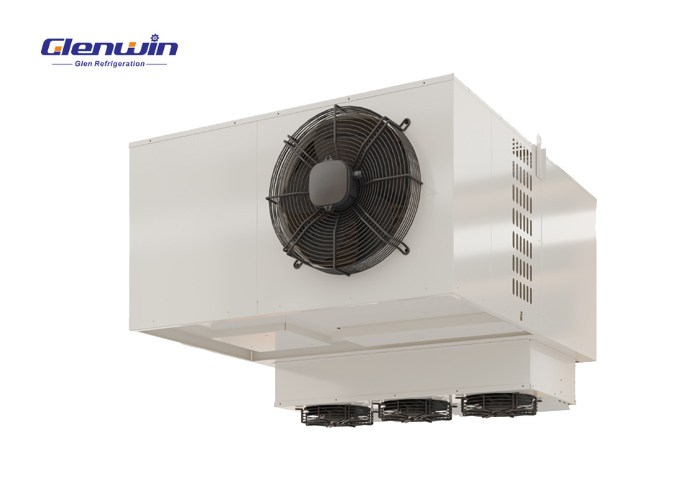
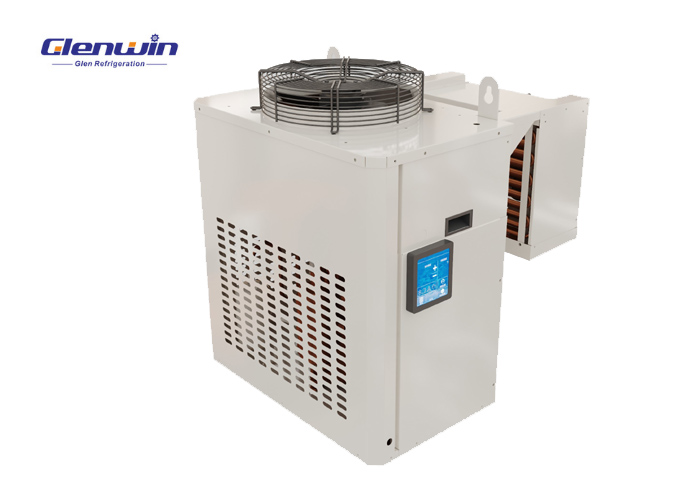
- Simple Selection of the Monoblock Refrigeration Unit for Walk-in Cooler
| Model | Horsepower | 2°C~8°C cold storage room volume (m3) | -15°C~-18°C freeze storage room volume (m3) |
| GL-BYTCN10EL | 1 HP | ≤12 m3 | ≤7 m3 |
| GL-BYTCN20EL | 2 HP | ≤25 m3 | ≤15 m3 |
| GL-BYTCN30EL | 3 HP | ≤40 m3 | ≤25 m3 |
| GL-BYTCN40EL | 4 HP | ≤55 m3 | ≤35 m3 |
| GL-BYTCN50FL | 5 HP | ≤65 m3 | ≤43 m3 |
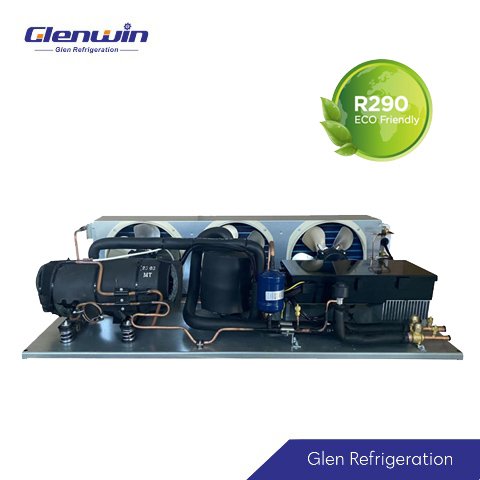
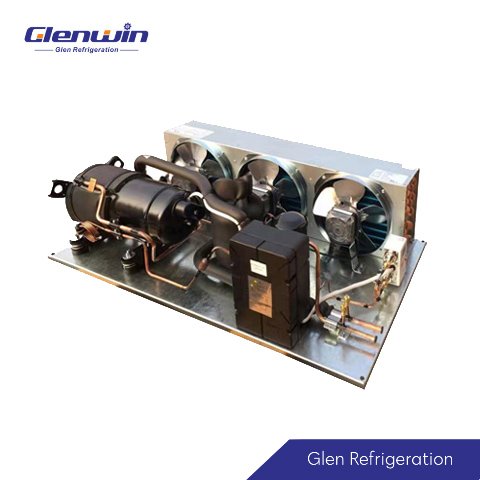
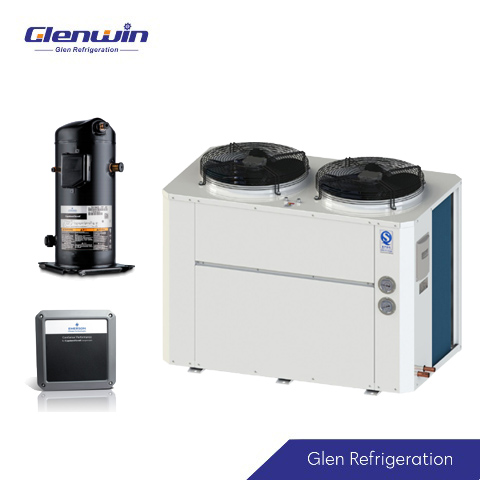
Glen Refrigeration offers different series of split refrigeration units inlcuding cold room outdoor condensig unit and indoor unit below:
- Sanyo compressor outdoor condensing unit from 1 HP to 3 HP
- Panasonic compressor outdoor condensing unit from 4 HP to 12.5 HP
- ZB series Emerson Copeland compressor outdoor condensing unit from 2 HP to 30 HP
- ZF series Emerson Copeland compressor outdoor condensing unit from 3 HP to 18 HP
- ZFI series Emerson Copeland compressor outdoor condensing unit from 4 HP to 30 HP
- Evaporator for cold room and freezer room
Split refrigeration units with wide range of cooling capacity and flexible installation, they are widely used in small walk-in coolers, medium walk-in coolers and large walk-in coolers.
- Simple Selection of the Split Refrigeration Unit for Walk-in Cooler
| Area (m2) | Height (m) | Outer Volume (m3) | OCU Model | Evaporator Model |
| 4.5 | 2.6 | 12 | GL-SN10EL | GL-DD15-301E |
| 6.5 | 2.6 | 17 | GL-SN15EL | GL-DD15-301E |
| 11.5 | 2.6 | 30 | GL-SN25EL | GL-DD30-302E |
| 15 | 2.6 | 40 | GL-SN30EL | GL-DD40-302E |
| 19 | 2.6 | 50 | GL-SN30EL | GL-DD40-302E |
| 25 | 2.6 | 65 | GL-GN40FM | GL-DD50-352F |
| 27 | 2.6 | 70 | GL-GN40FM | GL-DD50-352F |
| 38 | 2.6 | 100 | GL-GN50FM | GL-DD60-402F |
| 50 | 2.6 | 130 | GL-GN60FM | GL-DD70-402F |
| 57 | 2.6 | 150 | GL-GN70FM | GL-DD80-452F |
| 56 | 3 | 170 | GL-GN80FM | GL-DD100-403F |
| 63 | 3 | 190 | GL-GN80FM | GL-DD100-403F |
| 80 | 3 | 240 | GL-GN100FM | GL-DD120-453F |
| 105 | 3 | 320 | GL-GN130FM | GL-DD150-503F |
| 133 | 3 | 400 | GL-GN150FM | GL-DD180-504F |
| 200 | 3 | 600 | GL-GN200FM | GL-DD220-504F |
| 215 | 3.5 | 750 | GL-GN120FM*2 | GL-DD150-503F*2 |
| 285 | 3.5 | 1000 | GL-GN150FM*2 | GL-DD180-504F*2 |
| 340 | 3.5 | 1200 | GL-GN120FM*3 | GL-DD150-503F*3 |
| Note: Condensing unit GL-SN10EL, “10” means 1HP; Condensing unit GL-SN15EL, “15” means 1.5HP; | ||||
Are you interested in more details? Please see: Walk-in Cooler Refrigeration Unit
Then contact us now!
Contact us by Whatsapp 0086 15057108995 or email: info@greehvacr.com.
We look forward to your inquiry!